How to Pose for Acting Headshots That Get Cast Faster
Casting teams are fast. One widely cited guideline says they spend an average of just 8 seconds reviewing each photo (acting headshot guidance). That means posing isn't a style choice. It's a sorting mechanism.
If you're learning how to pose for acting headshots, stop thinking like a model and start thinking like someone feeding a generation system the cleanest possible acting signals. In AI actor portraits, tiny physical choices matter twice. First in the upload photos you provide. Then again in the generated variations that build on those choices. Good inputs give you usable looks faster. Bad inputs force more rerolls, more editing, and more guesswork.
Traditional headshot advice usually assumes a photographer will coach you in real time. Generative portraits change that. You need a repeatable pose, a controlled expression range, and smart upload variety. Get those right and you can build commercial, theatrical, and character-ready images much faster than scheduling a full shoot.
Why Your Pose Decides Your Callback in Seconds
Casting decisions start fast. Before anyone reads your credits, your photo has already signaled type, confidence, emotional availability, and whether you look castable right now.
Pose controls all of that.
A bad pose muddies the signal. A square, stiff chest can make you look guarded. A pulled-back chin softens the jaw and reads uncertain. Dead-on symmetry can flatten personality. Casting will not stop and decode what you meant. They move on.
That matters even more if you're creating AI headshots with Secta Labs instead of booking a traditional shoot. Generative tools are only as good as the visual information you feed them. If your upload photos show clean posture, clear intention, and small but readable shifts in energy, the model gives you stronger actor portraits faster. If your pose is vague, the output gets vague. Then you waste time rerolling versions that still do not feel like you.
Transform Your Professional Image
Get stunning AI-generated professional headshots in under an hour. Upload regular selfies or group photos, choose from over 100 styles and we'll create hundreds of perfect shots that represent your best self.
Posing is casting communication
Strong posing for actors has nothing to do with fashion posing. It is about transmitting one clear idea through the camera. Who are you? What roles do you book? What emotional temperature lives naturally in your face?
That is why simple headshots keep winning. Recent trend coverage points to controlled candid portraits, real skin texture, warmer grading, and less obvious posing in 2026 casting preferences (2026 casting trend coverage). Casting still wants readability first. Clean structure around the eyes, jaw, and mouth gives them that.
Actors miss this point all the time. They chase variety by changing outfits, hairstyles, or backgrounds, while the core issue is physical confusion in the frame. If your shoulders, neck, and eyes are sending different messages, the image feels off even when the lighting is great.
Small physical changes create better AI outputs
The AI approach becomes practical here. You are not posing to impress a photographer. You are building strong source material for generation.
Use pose adjustments that create distinct, repeatable inputs:
- Lift through the crown of the head to clean up the neck and sharpen attention.
- Relax the mouth corners to remove the forced “headshot smile.”
- Set the shoulders with intention so the image reads open, grounded, or guarded on purpose.
- Shift weight slightly to create asymmetry, which gives the portrait life.
- Aim the eyes with a point of view so the portrait feels castable, not vacant.
Those micro-adjustments give AI more usable information to work with. One upload set can produce a credible commercial look, a sharper theatrical option, and a more specific character portrait without rebuilding your whole setup.
That is why pose decides so much, so quickly. It shapes what casting sees first, and with AI portraits, it shapes what the system can generate at all.
The Core Posing Formula Every Actor Should Master
Actors waste whole sessions chasing variety when one repeatable pose does most of the work. Get the base pose right, and you give casting a clear read. You also give Secta Labs cleaner input photos, which leads to faster, more believable AI actor portraits.
Start with a body angle, not a face trick. The pose should create shape through the torso, keep the jaw clean, and let the eyes stay available. A practical actor-headshot approach recommended by photographers is to angle the body slightly off camera, return the face to lens, and bring the chin forward before lowering it slightly (actor headshot posing notes).
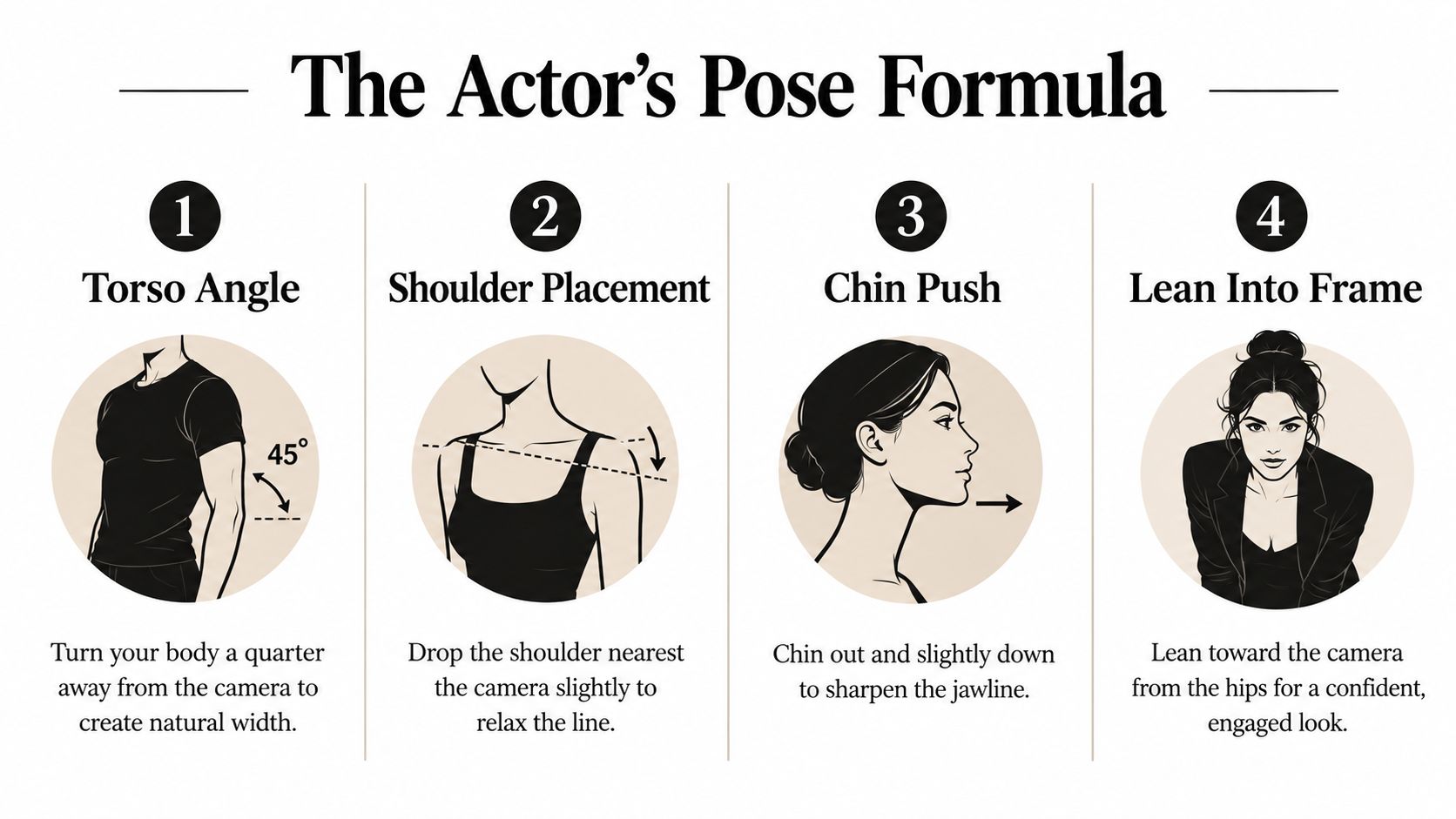
Build the pose from the ground up
Use your mirror or front-facing phone camera and set the pose in this order:
- Place your feet and release your midsectionStand with your weight balanced and your knees easy. If your ribs are braced, your mouth will tighten and the shot will read strained.
- Turn your torso about 20 to 30 degreesTurn the chest first. That small angle slims the frame, adds dimension, and keeps you out of the flat passport-photo look.
- Bring the face back to cameraYour body stays angled while your attention comes forward. That contrast is what makes a headshot feel alive instead of posed.
- Send the chin forward, then lower it a fractionForward creates separation under the jaw. Down adds definition. Reverse that order and you compress the neck.
- Come toward the lens by an inchA slight lean adds presence. More than that starts to look aggressive and distorts the proportions Secta Labs has to interpret.
The pose errors casting notices immediately
Three mistakes show up over and over in weak actor headshots.
- Square shoulders make you look broader and less specific.
- A chin pushed down instead of forward softens the jaw and drains alertness from the face.
- Overcorrected posture creates neck tension and a stiff mouth.
Here is the test I use in every session. If the jaw gets blurrier, the shoulders get heavier, or the face looks like it is trying too hard, reset.
Why this formula works better for AI headshots
AI portraits reward consistency. If your upload set includes five versions of the same strong angle, Secta Labs can produce better commercial, theatrical, and character options without fighting bad reference material. If your photos jump between slumped posture, square stance, and random chin positions, the outputs drift too.
Treat each pose as training data. Clean angle in, clean portrait out.
Small corrections that improve your results fast
Use these specific adjustments based on what the camera is doing to your face:
- Round face reading too wide: turn the torso a few degrees more and keep the nose from breaking too far past the cheek line.
- Jaw disappearing: move the forehead and chin slightly toward camera together, then lower the chin a touch.
- Glasses taking over the frame: keep the head level and lower the chin only enough to control glare.
- Feeling awkward on camera: lock the body position and repeat it while making tiny changes, so your upload set stays usable.
- One side feels stronger: shoot slight left and slight right versions on purpose, so the generator learns both.
Good posing is not modeling. It is clear signal design. Give the camera, and the AI system, a readable structure to work from.
Dialing In Expression and Eye Contact for Every Casting Type
Casting reads expression faster than posture. If your face sends a mixed signal, the pose underneath it will not save you.
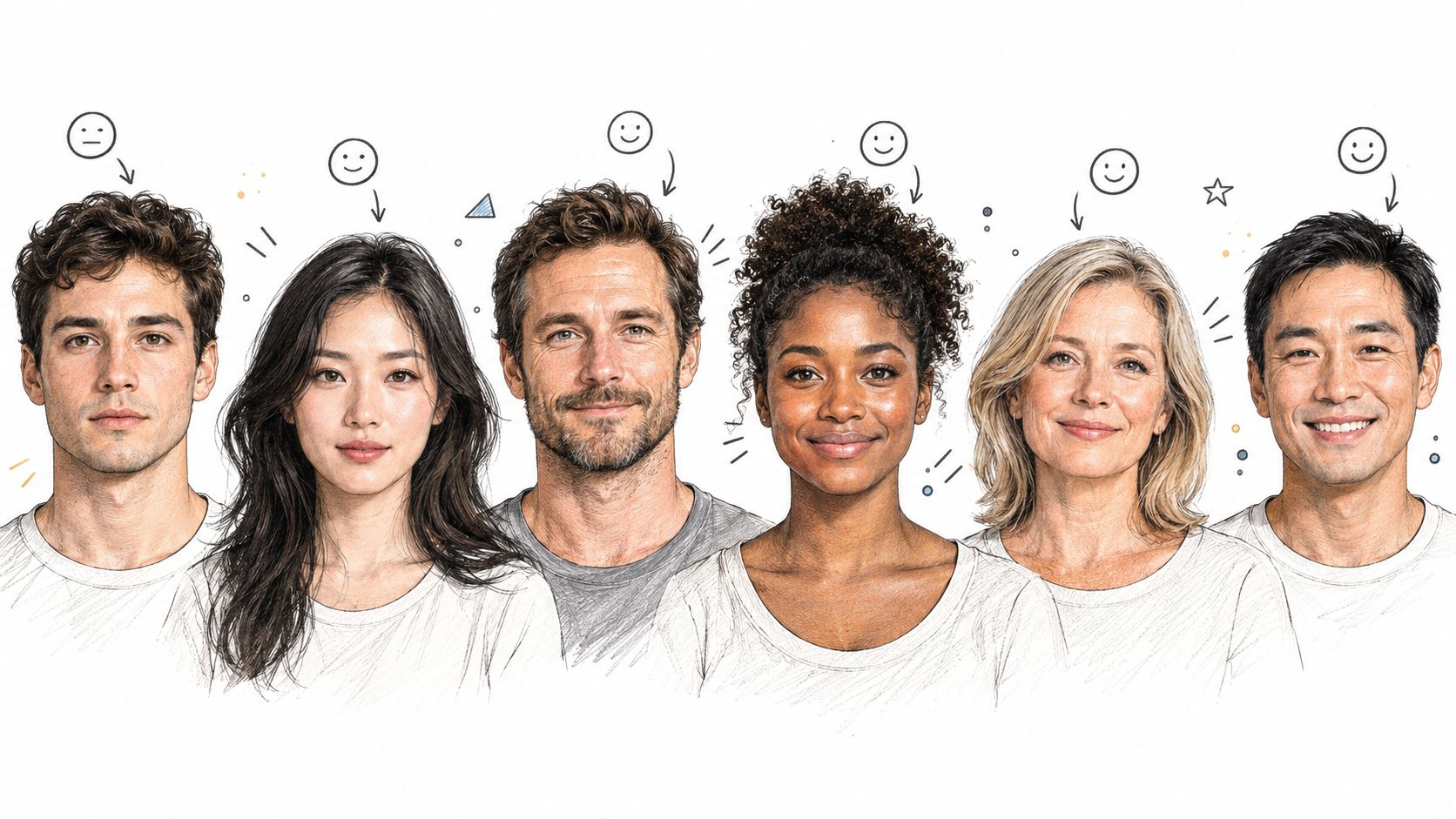
Actors miss here by pushing too hard. They throw on a grin, then flatten into fake seriousness, then try to look intense. Casting does not reward that. Neither does AI. Secta Labs generates stronger actor portraits when your upload set shows clear, controlled shifts instead of four unrelated faces.
Build a usable expression ladder
Keep the same general angle and run four versions. This gives the generator clean emotional inputs and gives you a wider casting range without muddying your likeness.
- NeutralSettle the mouth. Keep a trace of life in the eyes. Blank reads amateur.
- Slight smileLift the corners of the mouth a little. Let the eyes soften with it. This is your commercial baseline.
- SeriousRemove the smile, not the presence. Keep the brow smooth and the lips loose.
- Soft-intenseNarrow your focus, not your eyes. Bring your attention to one thought and let the jaw stay easy.
That sequence works because it creates separation without distortion. You are teaching the system what your face looks like across believable casting reads.
Set the eyes for the job
Eye direction changes the category immediately. Direct lens contact feels open, accessible, and sellable. A slight look just off camera feels more private and story-based. Character work can use either one, as long as the attitude is specific.
Use this simple map:
If you need help choosing between those lanes, review the difference between commercial and theatrical headshots before you build your upload set.
Make micro-adjustments, not big acting choices
I coach eye contact by millimeters. Raise the lower eyelids slightly. Let the pupils settle before the shutter hits. Release the tongue from the roof of the mouth so the lips stop pressing. If one eye reads larger, turn a fraction toward your narrower side. These tiny corrections matter in a headshot, and they matter even more in AI portraits because the system repeats whatever pattern you give it.
A good expression looks inhabited. It does not look performed.
Match the expression to the work you want
Do not submit cheerful eyes for dark drama. Do not submit dead, heavy intensity for upbeat commercial casting. Pick a lane and feed the generator references that stay inside it.
Use these corrections:
- Smile looking pasted on: breathe out, part the lips slightly, and smile with less mouth.
- Serious look getting harsh: soften the brow first, then refocus the eyes.
- Intensity turning blank: give yourself a specific thought so the eyes have direction.
- Face tightening after several shots: reset the jaw and swallow once before the next frame.
Actors usually need less performance and more precision. Cleaner expression inputs give Secta Labs more to work with, and your final headshots read like you on your best casting day.
Wardrobe Framing and Background That Keep Focus on You
I've seen actors ruin a good pose with a noisy shirt and a distracting background. If the clothing speaks louder than your face, the image loses. AI portrait generation follows the same rule. Cleaner visual choices give you more believable results and easier edits.
One headshot history and industry overview notes that actors should usually maintain at least two looks, often a serious theatrical shot and a smiling commercial shot. The same source also says professional sessions may produce 100–400 images with only 2–4 final retouched selects (headshot workflow and selection context). That's a useful reminder: most frames aren't winners. Readability is what narrows the field.
What the frame should do
Your framing should support the face, not compete with it. Head-and-shoulders is usually the cleanest zone for actor portraits because it keeps attention where casting looks first.
Heavy makeup, busy patterns, and overly stylized presentation are specifically warned against in actor headshot guidance. Good. They should be. Those choices create noise, and noise makes generated portraits less consistent.
For clothing ideas that keep the image simple and face-first, review this breakdown of the best clothes for a headshot.
What helps versus what hurts
Why this matters more in AI portraits
Generative tools can change clothing, background, and styling after upload. But they still need clean visual logic to work from. If your references are cluttered, the system has to solve too many problems at once.
Keep your upload wardrobe tight and neutral. Keep your backgrounds simple. Give the model a clear read on your face shape, neck line, shoulders, and type.
That approach also makes it easier to test several role categories quickly:
- Commercial set: softer top, brighter expression, cleaner backdrop
- Theatrical set: darker or more grounded styling, less smile
- Character set: one specific wardrobe cue, but still face-led
You don't need dramatic styling shifts in the inputs. You need enough structure that your generated portraits stay believable.
Turn Your Best Poses Into AI Actor Headshots in Minutes
Actors either save time or waste it here. If your source images are disciplined, AI headshots become a fast casting tool. If your uploads are random selfies with inconsistent angles and expressions, you'll spend your time fixing avoidable problems.
One AI actor-headshot provider says users can generate theatrical, commercial, cinematic, or outdoor looks in under 10 seconds after starting from a clear, front-facing selfie in good lighting (AI actor headshot workflow example). The exact speed varies by tool, but the lesson is solid: clean starting images make fast iteration possible.
What to upload
For generative actor portraits, variety beats volume until the variety gets sloppy. One source recommends 3–5 high-quality photos, while another suggests 10–20 selfies, with an emphasis on clear light, direct eye contact, and avoiding heavy filters (AI actor headshot input guidance).
I like a practical middle path. Use a compact set with controlled variation:
- One straight-on reference with neutral expression
- One slight turn left with a soft smile
- One slight turn right with serious focus
- One direct commercial look with open eyes and approachable energy
- One theatrical look with quieter mouth and stronger internal focus
That's enough diversity to teach the system your structure without confusing it.
Change one variable at a time
This is the habit that saves the most time. Generative AI actor-headshot tools often let you control lighting, background, expression, attire, and framing after upload, and one system explicitly recommends changing only one variable at a time when testing a look (AI headshot iteration guidance).
Do that.
If you change outfit, crop, expression, and background all at once, you won't know what made the image better. Keep the process clean:
- Lock a base expression.
- Test background.
- Keep background, change attire.
- Keep attire, adjust expression.
- Then compare commercial, theatrical, and cinematic directions.
This is also the only place I'll name a tool directly. Secta Labs lets users upload personal photos, generate 100–200+ HD images in under two hours, and edit clothing, expressions, backgrounds, hair, lighting, retouching, and upscaling afterward, according to the publisher information provided for the platform. For actors, that means you can start with a strong pose set, then refine casting lanes without rebooking a photographer.
A practical actor workflow
Use one batch of uploads and build three galleries:
- Commercial galleryDirect eye contact, slight smile, lighter styling, open energy.
- Theatrical gallerySame facial angle, quieter mouth, more focused eyes, simpler mood.
- Cinematic or character galleryKeep the likeness grounded and change only the atmosphere or attitude.
That workflow is faster and easier because the pose is doing the heavy lifting. The AI isn't inventing your casting essence. It's extending the signals you gave it clearly.
Your Next Casting Ready Portrait Starts Now
Actors who still pose like they're being photographed for a formal studio comp card are behind the moment. The current shift is toward controlled candid work. Real skin texture. Warmer grading. Subtle expression. Small posture corrections. The 2026 trend coverage cited earlier points in that direction, and casting taste has been moving there for a while.
That doesn't mean “just be natural” and hope for the best. Natural without control usually reads flat. You still need decisions. Turn the torso slightly. Set the shoulders down. Bring the chin forward and a touch down. Choose a specific eye line. Then make tiny expression changes that fit the roles you want.
Your pose should be personalized
The best answer to how to pose for acting headshots isn't a universal checklist. It's a stable base plus micro-adjustments that suit your face, your energy, and your casting lane.
Keep these principles:
- Build one reliable base pose that gives your face shape and presence.
- Vary expression in small increments instead of jumping between extremes.
- Simplify wardrobe and background so the face stays dominant.
- Feed AI systems clean reference logic so you get useful results faster.
If you want a practical framework for planning your looks before generating new portraits, this actor headshot template is a smart place to start.
The next move is simple. Take a short set of clear reference photos with controlled pose variation. Keep the changes small and intentional. Then generate a portfolio that covers your real casting lanes instead of gambling on one expensive session and hoping a few frames land.
If your current headshot doesn't look like the roles you're ready to book, fix the inputs first. The pose is where the correction starts.