Quality Assurance Standards for AI Headshots
1,474,118 active ISO 9001 certificates were reported worldwide in 2024, and that matters to an AI headshot buyer for one simple reason: quality only scales when the acceptance rules are written down. If you're evaluating an AI portrait studio right now, the question isn't whether the demo images look good. It's whether the vendor can prove, every time, that your face still looks like you, your prompt was followed, and the final set stays consistent across a whole team.
That's the point where most buyers get stuck. One studio shows polished samples. Another says it uses AI quality checks. A third talks about compliance, enterprise readiness, and review pipelines. But if you're the founder, HR lead, or brand manager who has to approve the purchase, you don't need abstract quality language. You need a standard that maps directly to the failures you care about in generative portraits.
In this context, quality assurance standards are not theory. They are the operating rules that decide whether a generated headshot is accepted, regenerated, escalated, or rejected. They turn fuzzy reactions like “this feels a bit off” into repeatable calls about identity drift, framing, brand fit, and prompt accuracy. They also help customers get to usable final portraits quicker and with less back-and-forth, because weak images get filtered out before delivery instead of becoming revision requests later.
Why Every AI Headshot Needs a Quality Standard
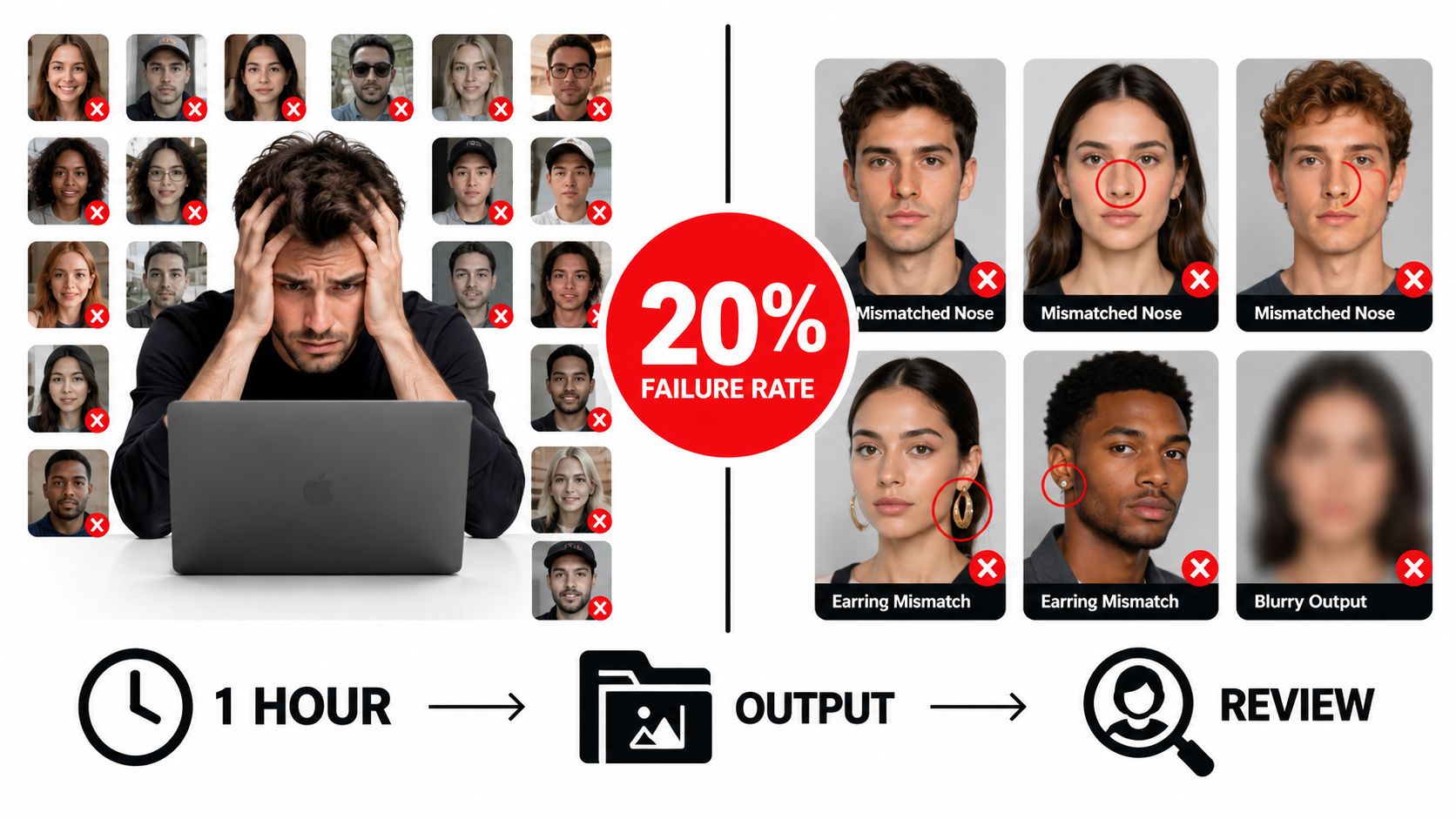
A familiar failure looks like this. A founder uploads a batch of selfies for a new executive profile set. An hour later, the folder arrives. Several portraits look polished at first glance, but one has a different nose shape, another changes the earrings, and another looks like a relative instead of the founder.
That isn't a cosmetic issue. It creates refund risk, LinkedIn embarrassment, internal approval delays, and possible likeness problems if a company publishes an image that no longer represents the person. In generative AI headshots, the model can produce impressive outputs and still miss the person.
Transformez votre image professionnelle
Obtenez de superbes photos professionnelles générées par l'IA en moins d'une heure. Téléchargez des selfies réguliers ou des photos de groupe, choisissez parmi plus de 100 styles et nous créerons des centaines de clichés parfaits qui vous mettront en valeur.
Why luck is not a process
Generative portrait systems are non-deterministic. You can use the same source set, similar prompts, and the same intended style, then still get variation in face structure, lighting behavior, accessories, and expression. Without a written standard, the team reviewing outputs is relying on taste and memory.
That works for a hobby project. It breaks when you need a team gallery, a board page, a recruiting site, or a company-wide rollout.
A useful standard for AI headshots has to catch four kinds of failure:
- Identity drift so the subject still looks like the same person
- Mechanical defects such as bad framing, blur, export issues, or unusable crops
- Prompt misses when the model ignores wardrobe, backdrop, or use-case instructions
- Brand mismatch when the image may be flattering but doesn't fit the company's visual rules
What buyers should look for
When founders compare AI portrait vendors, they often focus on speed, style variety, and price first. Those matter. But the faster route to a successful purchase is asking how the vendor prevents bad outputs from reaching you in the first place.
That's also why some buyers compare AI output against more traditional options such as commercial headshots from Pinnacle. The useful comparison isn't film camera versus model inference. It's whether either workflow has a defined acceptance bar that protects the customer from rework.
A strong QA standard makes the customer journey quicker and easier because the rejection logic is built into the system, not outsourced to your inbox on delivery day.
What Quality Assurance Standards Actually Mean
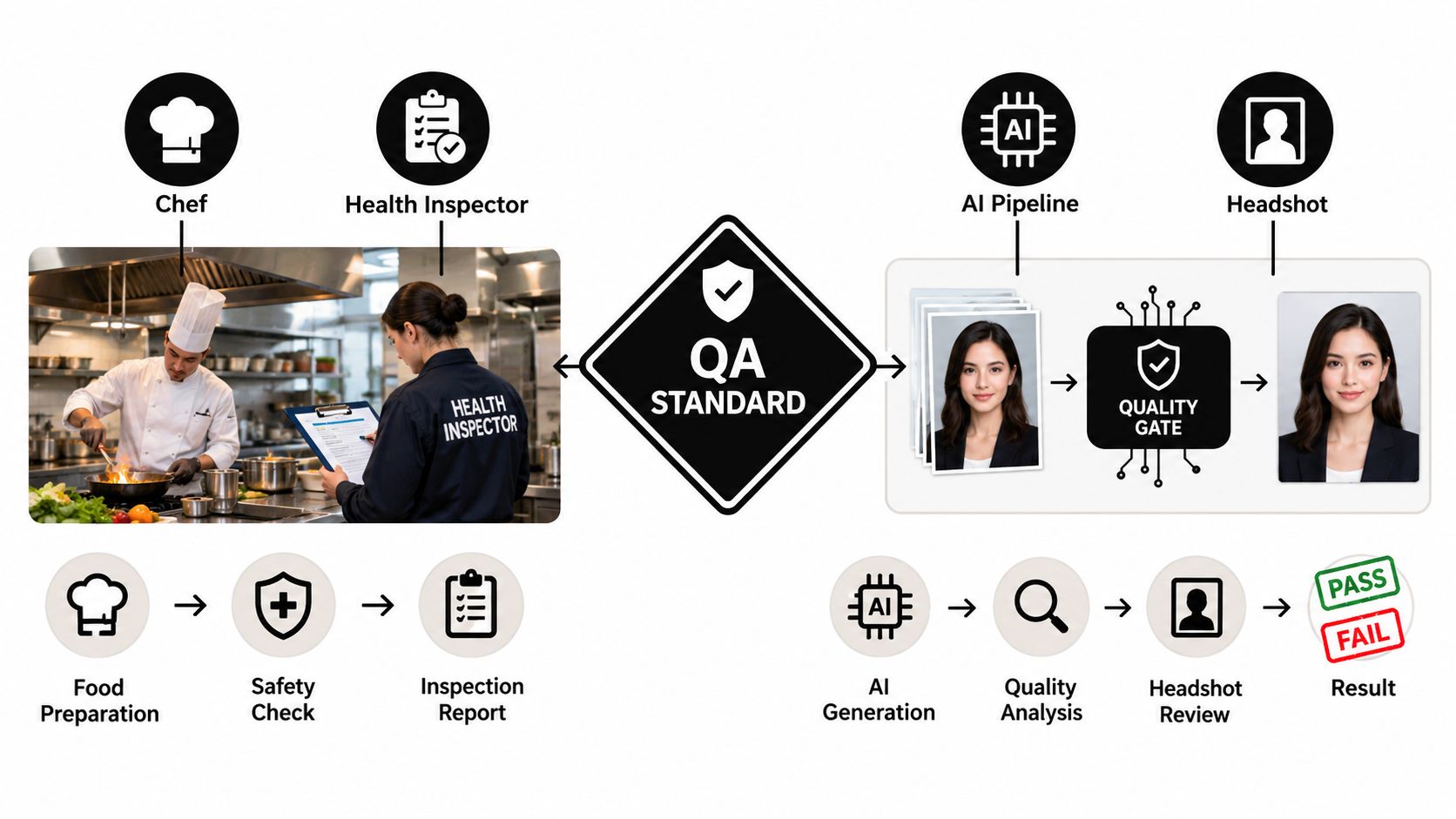
The easiest way to understand quality assurance standards is to stop thinking about ISO language for a minute and think about a restaurant kitchen.
A restaurant might serve excellent food on a slow night. That tells you the chef can cook. It doesn't tell you the kitchen can maintain safety and consistency when the room fills up, a new cook joins the line, or an inspector walks in. Standards exist for those stressed conditions.
AI headshot generation works the same way. A vendor can show a handful of beautiful portraits. That proves the tool can generate attractive images. It does not prove the workflow can repeatedly deliver acceptable portraits across many users, styles, prompts, and review teams.
The plain-English definition
In an AI portrait workflow, a quality assurance standard is a written agreement about four things:
- What acceptable output looks like
- How acceptance is measured
- Who checks which stage
- What happens when an image fails
That's the difference between “professional-looking portrait” and “accepted only if identity is preserved, the crop fits the delivery format, the requested wardrobe appears, and the image passes final review.”
The three parts every standard needs
Most solid QA systems, whether formal or lightweight, share the same building blocks.
- A quality policy that states intent. For a headshot studio, that might be preserving likeness, meeting brand requirements, and preventing unusable outputs from reaching customers.
- Measurable criteria that convert taste into decisions. Instead of “looks realistic,” the team uses specific checks for sharpness, facial consistency, framing, or prompt adherence.
- An audit loop that catches drift. If acceptance rates suddenly change, or one style starts producing identity errors, the team reviews the process rather than guessing.
That matters even more in AI workflows, because model behavior can drift across prompts, tuning changes, and different review staff. A documented standard keeps decisions stable when the business grows.
For readers who want a software-oriented explanation of how QA frameworks become repeatable operating rules, the expert QA guide from Nerdify is a useful companion. The core lesson carries over cleanly to headshots. Good QA reduces subjective review and makes output quality easier for customers to trust.
The Frameworks That Shape Modern Image QA
If you hear a vendor mention ISO, that doesn't mean the standard is grading each portrait. It usually means the business has adopted a management approach for how quality is planned, checked, documented, and improved.
The history matters because it shows why these frameworks became so widely used. ISO 9001 traces back through MIL-Q-9858 in 1963, NATO AQAP in 1968, BS 5750 in 1979, and the first ISO 9000 publication in 1987, with later revisions in 1994, 2000, 2008, and 2015. The lineage shows a long move from defense procurement controls to a broadly used management-system standard, as outlined in this ISO 9001 historical review.
What ISO 9001 really tells you
ISO 9001 is best understood as a system standard, not an image-aesthetic standard. It asks questions like:
- Are the steps documented?
- Are failures recorded and reviewed?
- Does leadership evaluate the process?
- Is there evidence of corrective action and improvement?
That's why ISO 9001 can be relevant to an AI headshot studio even though it doesn't decide whether your blazer looks right. It tells you whether the studio has a disciplined way to manage quality over time.
The scale of adoption is also a clue to its practical importance. The 2024 ISO Survey reported 1,474,118 active ISO 9001 certificates worldwide, and 2,963,855 active management-system certificates globally. An industry summary also noted that ISO 9001 certificates increased by about 60.8% from 2020 to 2024, according to the 2024 ISO survey reporting summary.
Other frameworks that matter in image workflows
For AI headshots, buyers should think in layers. One framework governs the operating system of the business. Another helps evaluate software behavior. Another focuses on AI risk.
What a small studio can borrow without full certification
A smaller AI portrait provider may never pursue formal certification, and that's fine. The question is whether it borrows the useful parts.
A good buyer asks for evidence of three behaviors:
- Documented intake rules so weak inputs don't poison the generation run
- Repeatable pass-fail criteria for outputs
- Corrective action records when a batch misses the bar
That is often more useful than a vague promise about “AI quality.”
Four Dimensions of an AI Headshot Quality Check
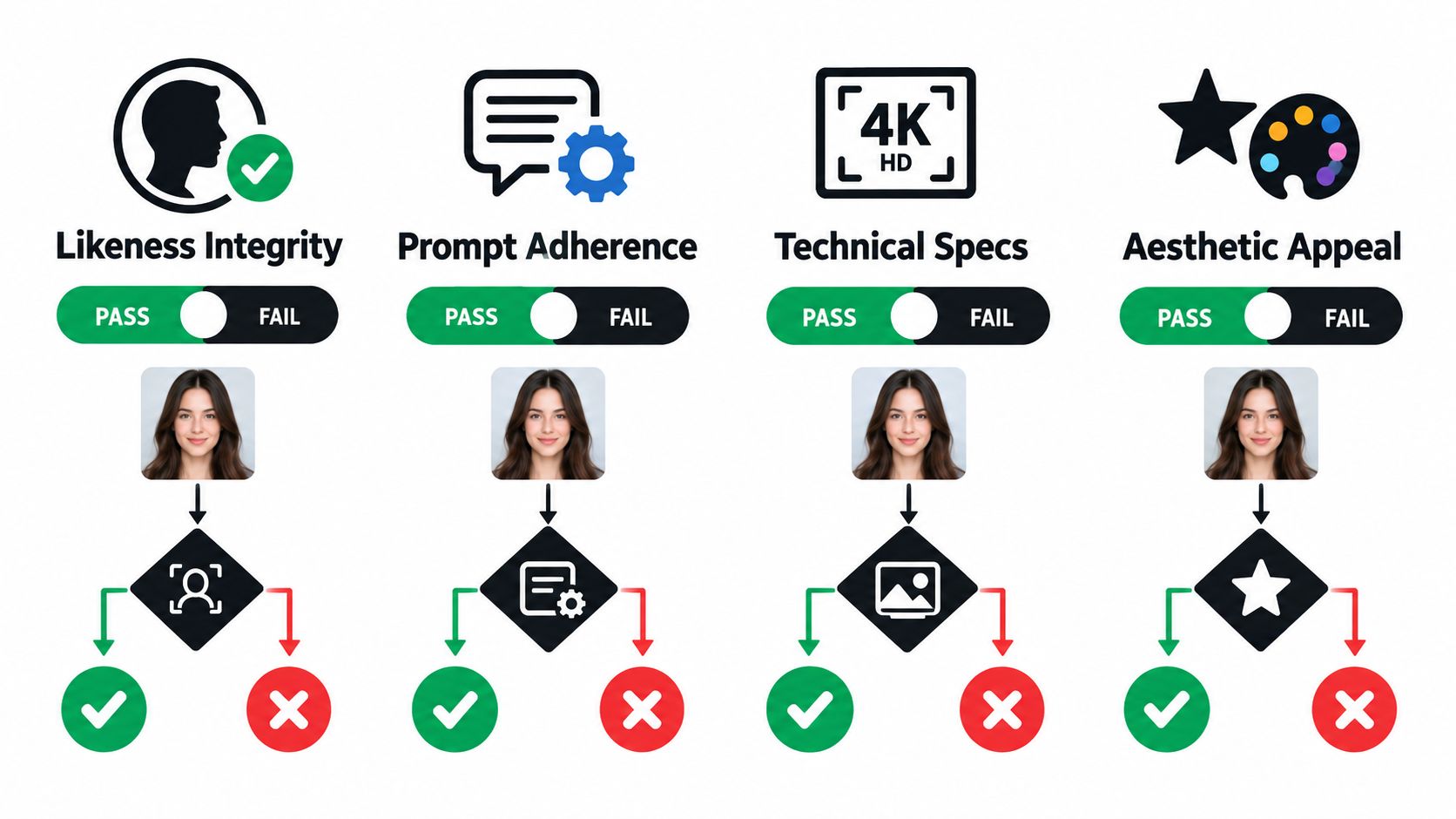
The most practical way to run quality assurance standards in generative portraits is to split review into four dimensions. This removes the common problem where one reviewer says an image looks good, another says it feels wrong, and nobody knows why.
Recent AI face-generation QA work frames image evaluation around Quality, Authenticity, ID Fidelity, and Correspondence, which is a helpful model for portrait workflows because it separates visual polish, realism, identity preservation, and prompt alignment into distinct checks, as described in this face-generation QA framework.
The four gates
Take a founder who requests a navy-jacket LinkedIn headshot with clean lighting and a neutral office backdrop.
- Technical compliance comes first. Is the file sharp, correctly framed, and deliverable in the requested format? If not, stop there. Don't waste time debating likeness on an unusable image.
- Likeness integrity comes next. Does the face still read as the same person, not a stylized cousin with altered facial structure?
- Prompt adherence follows. Did the model keep the navy jacket, the intended backdrop, and the right expression range?
- Presentation polish is the final layer. Does the image feel professional, balanced, and suitable for the platform where it will appear?
This sequencing matters because it reduces rework. Teams often fall in love with a flattering image, only to discover later that the crop is wrong or the file isn't suitable for delivery.
Why the order saves time
When the gates are in the wrong order, customers get dragged into avoidable review cycles. They comment on style before the team has verified identity. They choose favorites before failed images are removed. They ask for revisions that should have been automatic rejections.
For teams that care about visual consistency across many creators and profiles, tools outside the headshot category can still be useful references. The LunaBloom app for creators is one example of how AI users increasingly expect guided output standards rather than raw generation alone. In business portraits, that expectation becomes even more important because the image represents a real person and a brand.
Color handling is also part of this review sequence. A portrait can preserve identity and still feel wrong if skin tone rendering or wardrobe color shifts during generation. Secta's guidance on color accuracy in AI portraits is relevant here because it shows why visual correctness isn't only about beauty. It affects trust, recognition, and faster final approval.
Scoring Identity Fidelity and Mechanical Compliance
Quality assurance standards stop being philosophical and start becoming operational. You need a scorecard.
A practical approach combines an identity fidelity score with a mechanical compliance checklist. One tells you whether the person still looks like themselves. The other tells you whether the file is usable.
The identity score
A concrete portrait-evaluation rubric uses a 0 to 5 scale for identity fidelity, where 5 means clearly the same person, 3 means mostly the same person with noticeable drift, and 0 means the face is missing or unreadable, as shown in this multimodal image evaluation example.
In plain English, the bands look like this:
The mechanical threshold
Mechanical checks should be strict because they're objective. ISO/ICAO-style face-image checks use tests such as whether the face is fully inside the frame, whether eye distance and head width or height ratios are within limits, and whether the image is focused and sharp. In the cited SDK, an image is compliant only if all tests score at least 0.5, according to this face image compliance paper.
That gives you a very workable rule for AI headshots: if identity is below 4 or any mechanical check fails, regenerate the image before human review.
This is how customers get results quicker. Instead of reviewing a noisy gallery full of maybe-usable portraits, they receive a tighter set where the obvious failures have already been removed.
Auditing an AI Portrait Workflow End to End
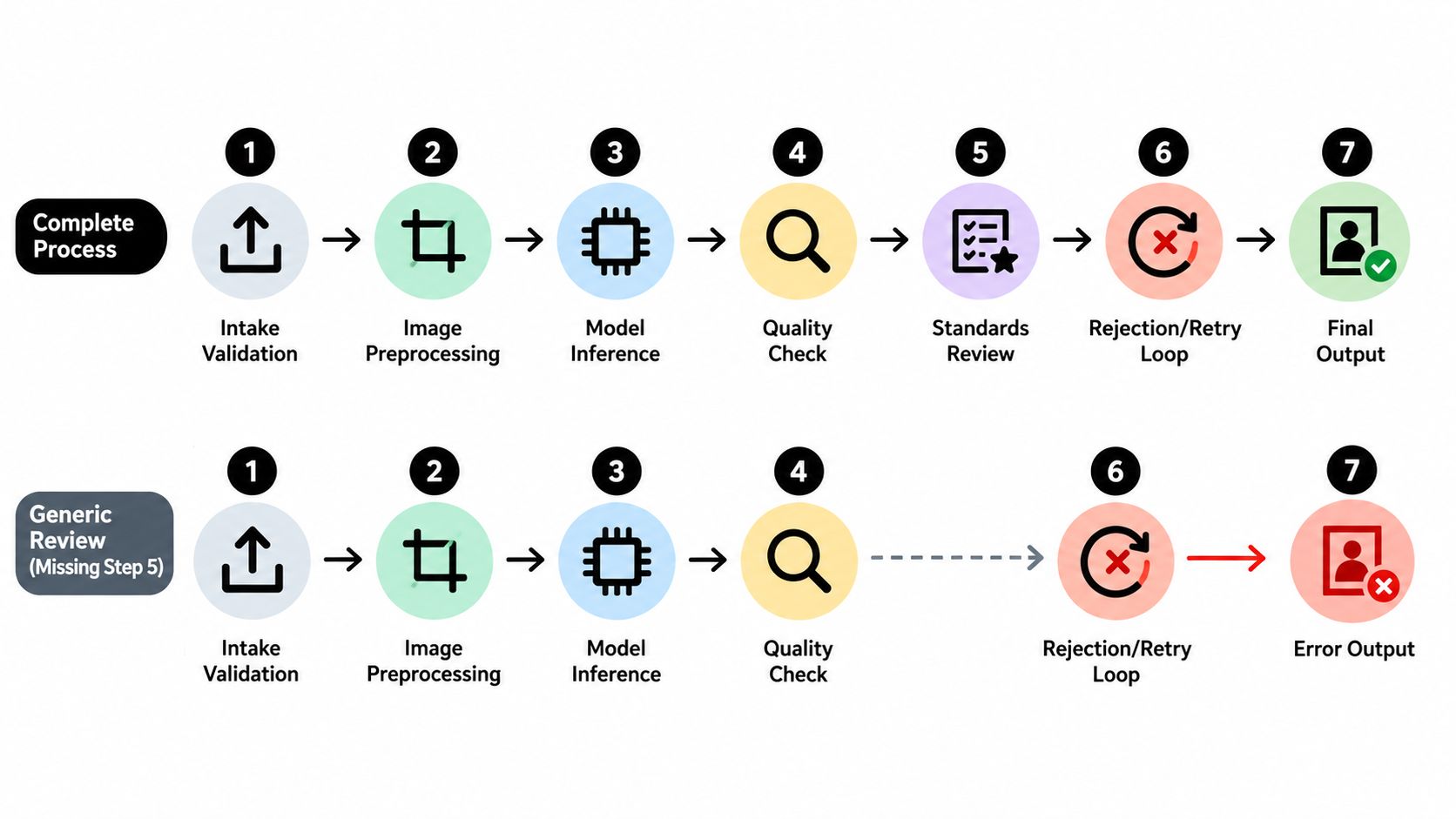
A generic review says, “The images look good.” A standards-driven audit asks, “At which exact step could a defect enter this batch, and where is the evidence that it was caught?”
That difference matters because many quality problems are introduced before generation starts. If intake images are weak, or consent records are incomplete, or prompt versions aren't logged, the team may still deliver good-looking portraits while carrying hidden risk.
What an actual audit checks
An end-to-end audit for AI portraits should move through the workflow in order:
- Intake validation checks source image quality, subject consent, and whether the upload set is likely to preserve identity.
- Prompt construction checks that wardrobe, background, expression, and use-case instructions are documented and versioned.
- Generation sampling checks whether the selected model and style setup are appropriate for the requested output.
- Rubric scoring checks identity, realism, and prompt alignment.
- Mechanical validation checks framing, sharpness, and export specs.
- Human spot review checks ambiguous edge cases.
- Final delivery review confirms the customer sees only approved outputs.
What casual review usually misses
A looser process often skips the evidence layer.
- Unverified provenance means nobody confirms the reference images support accurate generation.
- Undocumented prompt versions mean the team can't explain why one batch succeeded and another failed.
- Missing audit logs mean recurring errors stay anecdotal instead of becoming fixable process defects.
Recent audit findings outside image generation are instructive here because they show a recurring quality gap: many organizations document a system but fail in monitoring, root-cause analysis, remediation follow-up, and annual evaluation, according to the CPA Australia 2025 professional standards report. That's exactly the trap AI portrait vendors should avoid.
Data handling belongs in the same audit. If a vendor can't show how uploads, rejected outputs, and retained files are governed, the review is only half done. That's why procurement teams should look at practical policies like data retention policies for AI portraits during vendor evaluation, not after contract signature.
Scaling Consistent Quality Across Teams and Brands
A small pilot can survive on heroic effort. Enterprise rollout can't.
When five people generate their own portraits, inconsistency feels manageable. When a company needs hundreds or thousands of headshots across departments, regions, and job levels, every vague decision becomes a brand problem. One manager approves dramatic lighting. Another accepts casual wardrobe. A third signs off on images with slight identity drift because they “look polished enough.”
What breaks in fragmented programs
Without shared quality assurance standards, “professional” becomes a moving target.
One executive may appear cooler-toned and highly retouched while another appears warm, flat-lit, and more candid. Sales teams may receive different background treatments than leadership. Regulated teams may accidentally get wardrobe or styling choices that clash with internal policy.
Those aren't creative differences. They are signs that no one is operating from the same acceptance rules.
What a stable program looks like
A standards-driven team rollout usually includes these controls:
- One identity threshold so every person is held to the same likeness standard
- One prompt library with approved variants for role, region, or campaign use
- One exception path for edge cases that need manual review instead of silent approval
- One delivery review that checks consistency across the batch, not just image by image
For companies building team-wide portrait systems, corporate image guidelines for AI headshots are one practical way to define those controls before rollout.
Why this is faster for the customer
Consistency sounds restrictive until you manage a rollout. Then it becomes the thing that makes speed possible.
If each regional lead chooses prompts ad hoc, every batch generates fresh debate. If the company maintains versioned style rules and one acceptance rubric, approval gets easier because reviewers are judging against a stable target. Customers spend less time sorting mixed-quality galleries and more time selecting among already-on-brand options.
This is also the right place to mention tooling. Secta Labs is one example of an AI headshot studio that combines generation with editing, style selection, and team-use workflows. In a procurement context, what matters isn't the feature list alone. It's whether those tools sit inside a controlled process that protects identity, consistency, and review speed.
Your Practical QA Checklist Before You Buy
If you're evaluating an AI headshot vendor, don't ask for a broad explanation of quality. Ask for evidence at the exact moment a buying decision can go wrong.
Use this checklist during the demo and score the vendor in real time.
The buyer's checklist
- Framework checkAsk which quality framework the vendor uses in operations. You're not looking for buzzwords. You're looking for documented rules, review ownership, and corrective action.
- Identity scoring checkAsk how identity fidelity is scored and what threshold triggers rejection. If the answer is “our team just reviews it,” the process is still subjective.
- Failure handling checkAsk what happens when an image falls below the threshold. Strong vendors regenerate automatically or route edge cases to human review. Weak vendors pass uncertainty to the customer.
- Prompt versioning checkAsk whether prompts and style settings are versioned. If a batch goes wrong, can the vendor explain what changed?
- Retention and review checkAsk whether raw outputs and rejected images are retained long enough for audit and dispute resolution, and under what policy.
- Batch consistency checkAsk how the vendor checks team-wide consistency across wardrobe, background, expression range, and framing.
- Escalation checkAsk who reviews borderline images and what reason codes they use when rejecting them.
The question that exposes weak QA
Ask this and then stay quiet:
A mature vendor can answer with process evidence. An immature vendor will shift back to marketing language.
What a good answer sounds like
You want to hear specifics such as:
- rejected for identity drift
- rejected for framing failure
- rejected for prompt mismatch
- rejected for artifacting or background defects
- regenerated before delivery
You do not want to hear “the customer didn't like the vibe.”
One last practical note. Industry guidance is already moving toward AI governance, sustainability, Industry 4.0, and readiness assessments before standards updates take effect, as reflected in this internal audit quality services FAQ. For an AI headshot buyer, the implication is simple: don't just ask whether the vendor can generate portraits now. Ask whether its QA process can adapt as AI workflows, remote approvals, and digital evidence handling become more demanding.
That's what makes compliance a buyable feature instead of a sales promise.
The easiest vendor to approve isn't the one with the flashiest sample gallery. It's the one that can show you, clearly and quickly, why bad images never make it to your team.